
On this page (6 sections)
- 1.2026 Australian Nitrogen Supply Cost Comparison ($/Nm3 at $0.30/kWh)
- 2.Purity vs Feed-Air Demand Across Breweries, Wineries, MAP & Laser
- 3.Protecting CMS & Membranes: Mandatory ISO 8573-1:2010 [1:2:1] Feed Air
- 4.AS 4343:2014 Buffer Receivers, AS/NZS 3788:2024 & O2 Depletion Safety
- 5.Request My Introduction for On-Site Nitrogen & Feed-Air Sizing
- 6.Frequently asked questions
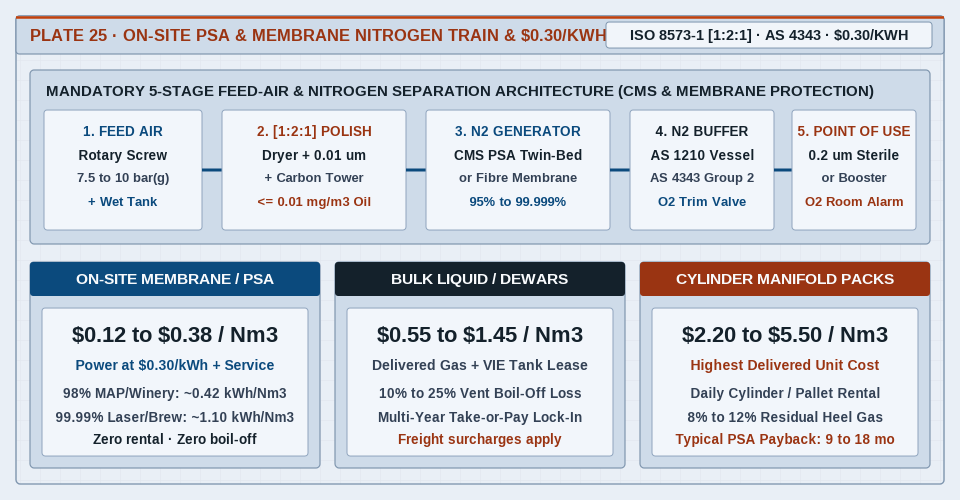
Direct Answer: At a $0.30/kWh Australian electricity tariff, generating nitrogen on site via PSA or membrane skids typically costs A$0.12 to A$0.42 per Nm3 in power and filtration, compared with A$0.55 to A$1.45/Nm3 for bulk liquid/Dewars and A$2.20 to A$5.50/Nm3 for cylinder manifold packs.
For Australian breweries, wineries, food MAP lines, and laser-cutting workshops consuming at least 15 to 30 Nm3/day, eliminating cylinder rental, hazmat delivery fees, and 10% to 25% liquid boil-off commonly delivers a 9 to 24 month simple payback.
1. 2026 Australian Nitrogen Supply Cost Comparison ($/Nm3 at $0.30/kWh)
Delivered gas invoices rarely show your true unit cost per usable cubic metre once daily manifold rental, dangerous-goods drop charges, cylinder residual heel gas (8% to 12%), and intermittent cryo-tank vent losses are included.
| Supply Mode | Purity Window | Specific Power ($0.30/kWh) |
2026 All-In Cost (AUD/Nm3) |
Best Australian Plant Fit |
|---|---|---|---|---|
| Cylinder Packs (12-16 G-size) | 99.9% to 99.999% |
Delivered high-pressure gas | $2.20 to $5.50 / Nm3 |
Intermittent purge or backup only (< 10 Nm3/day) |
| Liquid Dewars / Micro-Bulk | 99.99%+ |
Cryogenic liquid (10-25% boil-off) |
$0.95 to $1.85 / Nm3 |
Seasonal vintage peaks or short batch runs |
| Bulk Cryogenic VIE Tank | 99.999% |
Cryogenic liquid + vaporiser | $0.55 to $1.15 / Nm3 |
Very high continuous flow with contract lock-in |
| Hollow-Fibre Membrane Skid | 95% to 99.5% |
0.35 to 0.62 kWh/Nm3 |
$0.12 to $0.22 / Nm3 |
Food MAP, coffee, tyre & chemical blanketing |
| Twin-Tower CMS PSA Skid | 99.5% to 99.999% |
0.52 to 1.25 kWh/Nm3 |
$0.18 to $0.42 / Nm3 |
Breweries, wineries, pharma & fibre laser cutting |
Indicative turnkey 2026 Australian equipment budgets (generator skid + N2 buffer vessel + oxygen analyser, excluding feed air compressor if existing capacity is available) typically span A$18,000 to A$48,000 ex-GST for compact brewery/winery skids and A$55,000 to A$145,000+ for high-pressure 25 bar laser-assist packages.
2. Purity vs Feed-Air Demand Across Breweries, Wineries, MAP & Laser
Over-specifying nitrogen purity is the single most expensive sizing mistake on PSA installations. Separating the final 0.49% of oxygen to jump from 99.5% to 99.999% roughly doubles the compressed-air-to-nitrogen ratio (Air Factor):
- Food MAP & Dry Snacks (98% to 99.5% N2, 0.5% to 2% O2): Air factor sits around
2.4:1to3.3:1, consuming roughly0.40to0.58 kWh/Nm3(A$0.12toA$0.17/Nm3at$0.30/kWh; see Packaging Compressed Air). - Wineries & Craft Breweries (99.5% to 99.95% N2, 500 ppm to 0.5% O2): Tank headspace blanketing uses
99.5%, while bright-beer tank purging and canning lines target99.9%to99.99%(air factor4.0:1to5.2:1; compare Breweries and Wineries). - Fibre Laser Cutting (99.99% to 99.999% N2 at 16 to 25 bar): Bright oxide-free stainless and aluminium edges require
10to100 ppmO2 maximum plus a dedicated25to40 barN2 booster and high-pressure receiver bank (check base compressor FAD in the Compressor Sizing Calculator).
3. Protecting CMS & Membranes: Mandatory ISO 8573-1:2010 [1:2:1] Feed Air
Carbon Molecular Sieve (CMS) pellets inside PSA towers separate oxygen from nitrogen through microscopic 3 to 4 Angstrom pore kinetics. Any compressor oil aerosol or hydrocarbon vapour coats those pores permanently, destroying purity and forcing a costly A$8,000 to A$30,000+ CMS re-bed.
Specify feed air pre-treatment strictly to ISO 8573-1:2010 Class [1:2:1] (or [1:4:1] where indoor ambient stays well above +3 °C dew point): a sized refrigerated or desiccant dryer, 1.0 micron and 0.01 micron coalescing filters, and an activated-carbon tower holding total residual oil at ≤ 0.01 mg/m3.
Configure your exact upstream filtration cascade in our ISO 8573-1 Air Purity Specifier, and add a sterile 0.2 micron point-of-use filter plus scheduled food and beverage purity testing wherever nitrogen contacts wine, beer, or open food.
4. AS 4343:2014 Buffer Receivers, AS/NZS 3788:2024 & O2 Depletion Safety
On-site nitrogen plants typically include two pressure vessels: a wet compressed-air receiver ahead of the dryer and a dedicated N2 process buffer receiver (plus 25 to 300 bar cylinder banks on laser systems). Under AS 4343:2014, gaseous nitrogen sits in Fluid Group 2 alongside compressed air:
- Statutory registration & inspection: Check both vessels in our AS 4343 Hazard Level Calculator. Vessels with
P × V > 31.6 MPa.Lrequire design registration,> 100 MPa.Lrequire state item registration (for example Work Health and Safety Regulation 2025 (NSW) section 246; exempt in Victoria), and> 150 MPa.Ltrigger 2y/4y AS/NZS 3788:2024 inspections (see Air Receiver Registration Costs). - Confined-space asphyxiation controls: PSA oxygen-enriched exhaust must be piped safely outdoors away from ignition sources, while enclosed cellar, packaging, or plant rooms housing N2 lines require wall-mounted ambient oxygen depletion alarms set at
19.5% O2.
5. Request My Introduction for On-Site Nitrogen & Feed-Air Sizing
Want to benchmark your current monthly cylinder or bulk liquid gas bills against an independent Australian PSA or membrane nitrogen package? Share your monthly N2 usage, target purity, line pressure, and state below to request a 1-to-1 specialist introduction.
6. Frequently asked questions
How much does it cost to generate nitrogen on site per Nm3 in Australia at $0.30/kWh?
At the $0.30/kWh Australian commercial tariff, compressed-air electricity plus routine filter maintenance typically equals A$0.12 to A$0.18/Nm3 at 97% to 99% food/winery purity and A$0.28 to A$0.42/Nm3 at 99.99% to 99.999% brewery or laser-cutting purity, compared with A$0.55 to A$5.50/Nm3 for delivered liquid or cylinder packs.
Should our plant choose a PSA or a hollow-fibre membrane nitrogen generator?
Choose hollow-fibre membrane skids for compact, quiet, zero-moving-valve duties between 95% and 99.5% purity (coffee/snack MAP, tyre inflation, tank blanketing). Choose Carbon Molecular Sieve (CMS) PSA twin-tower generators when process specs demand 99.9% to 99.999% purity (dissolved-oxygen sensitive brewing, canning, electronics, and stainless laser cutting).
What compressed air purity is required upstream of a PSA or membrane nitrogen generator?
Both Carbon Molecular Sieve beds and polymeric hollow fibres suffer irreversible capacity loss if exposed to liquid water, oil aerosols, or hydrocarbon vapour. Specify ISO 8573-1:2010 Class [1:2:1] or [1:4:1] feed air (dryer + 0.01 micron coalescer + activated-carbon tower).
Do nitrogen buffer tanks require WHS pressure vessel registration in Australia?
Yes. Dry gaseous nitrogen sits in AS 4343:2014 Fluid Group 2 alongside compressed air. Vessels above 31.6 MPa.L require design registration, above 100 MPa.L require item registration (outside Victoria), and above 150 MPa.L require AS/NZS 3788:2024 inspections. Use the form above to request an introduction.