
On this page (6 sections)
Direct Answer: Any Australian workplace supplying compressed air to airline respirators, spray booths, abrasive blasting hoods, or confined-space breathing apparatus must test delivered air quality against AS/NZS 1715:2009 Appendix A at the point of use.
Testing is typically scheduled every 3 to 6 months (or immediately after compressor servicing, filter changes, or odour complaints) using an independent occupational hygiene consultancy or NATA-accredited testing laboratory.
1. AS/NZS 1715:2009 Appendix A Breathing Air Limits
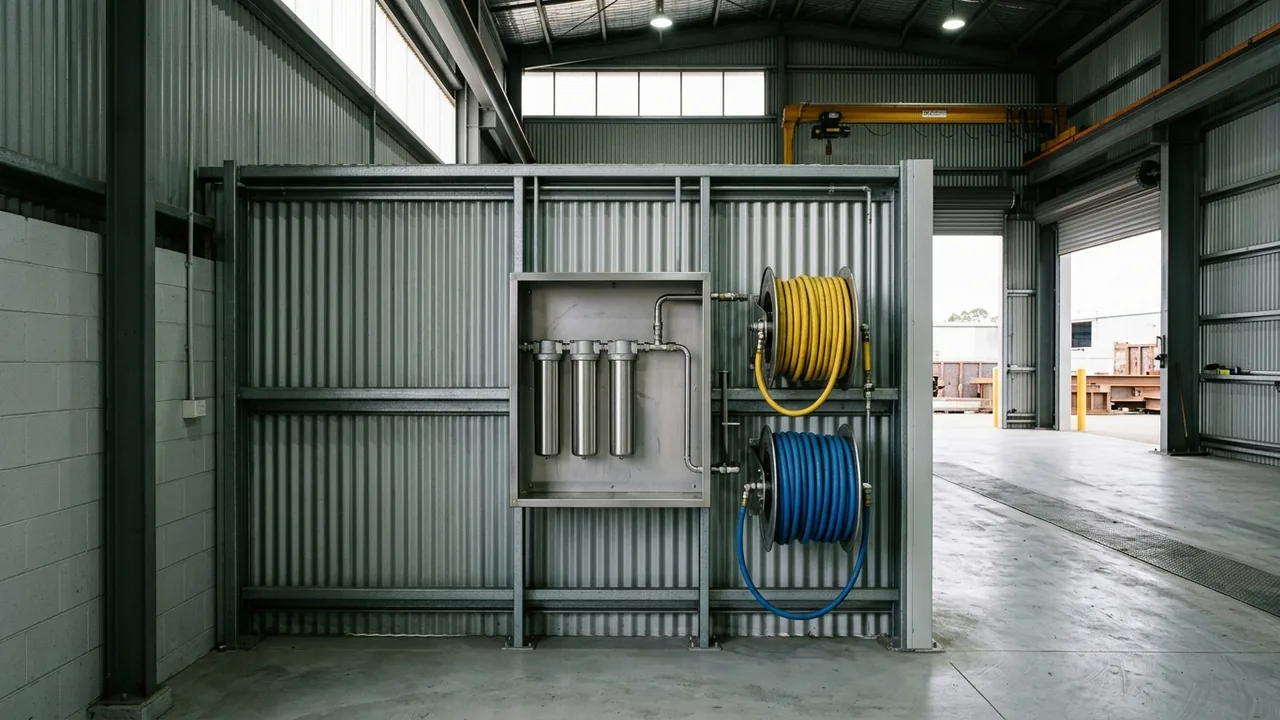
A compliant site test report measures five mandatory parameters downstream of the breathing-air filtration panel, at the exact outlet where workers connect their respirator hose.
| Parameter | AS/NZS 1715:2009 Appendix A Limit | Primary Failure Cause |
|---|---|---|
Oxygen (O2) | 19.5% to 22.0% by volume | Contaminated intake near nitrogen/argon lines or exhaust |
Carbon Monoxide (CO) | ≤ 10 ppm (11 mg/m3) | Overheated oil-lubricated compressor or engine exhaust near intake |
Carbon Dioxide (CO2) | ≤ 800 ppm (1,400 mg/m3) | Poor plant-room ventilation or forklift exhaust at compressor intake |
| Oil (Mist & Vapour) | ≤ 1 mg/m3 | Saturated coalescing (0.01 um) or activated-carbon filter elements |
| Odour & Taste | Free of objectionable odour or taste | Degraded carbon bed, stagnant condensate, or burnt compressor oil |
Note: Medical air produced from on-site hospital compressor systems is governed separately by AS 2568:2019 (IncAmd 1:2022), which applies stricter limits.
2. Indicative Breathing Air Testing Costs in Australia
Independent occupational hygiene consultancies generally price testing as a site mobilisation fee plus a per-outlet sampling rate.
| Site Scope | Typical Testing Protocol | Indicative Cost (AUD, ex GST) |
|---|---|---|
| Single Spray Booth or Workshop Outlet | On-site calibrated gas analysis (O2, CO, CO2) + oil mist/moisture check + compliance certificate | $650 to $1,100 |
| Multi-Outlet Industrial / Blasting Site (3 to 6 outlets) | Point-of-use sampling across all active breathing-air manifolds + NATA-endorsed report | $1,200 to $2,400 |
Food / Pharma Purity Suite (ISO 8573-1:2010) | Laser particle counter, pressure dew point (-40 C or +3 C), oil aerosol/vapour & microbial swab | $1,500 to $3,200 |
3. Why Independent Testing Matters for WHS & Audit Defence
WorkSafe inspectors, Tier-1 mining principals, and SQF/BRCGS food auditors increasingly reject self-signed test sheets issued by the same contractor who services the compressor.
Engaging an independent occupational hygienist or NATA-accredited laboratory gives you an audit-defensible certificate with traceable instrument calibration records and zero conflict of interest.
4. What to Check Before the Tester Arrives
Run through four quick checks 48 hours before your scheduled test to avoid paying for a re-test:
- Check compressor intake location: Confirm the air intake is ducted to clean outside air, well away from vehicle exhausts, welding bays, or paint fumes.
- Verify filter differential pressure gauges: Replace saturated coalescing and activated-carbon cartridges before testing, and log the change date.
- Confirm continuous CO monitor calibration: Where an oil-lubricated compressor feeds breathing air, verify the inline carbon monoxide alarm is within calibration.
- Drain condensate traps: Ensure auto-drains on the receiver and pre-filters are discharging cleanly so liquid water cannot carry over to the breathing panel.
5. Request 1-to-1 NATA Breathing-Air Testing Quote
Share your site postcode, number of breathing-air or ISO 8573-1 outlets, and industry below for a 1-to-1 introduction to an independent Australian air-testing specialist.
Matched 1-to-1 with one vetted independent Australian specialist (choose direct introduction or Ask-First permission check below; how we are paid).
Optional: Free 2-page PDF AS/NZS 1715 breathing-air checklist & site test logbook
Free 2-page PDF: AS/NZS 1715:2009 Breathing Air Checklist & Site Test Logbook
Print the AS/NZS 1715:2009 Appendix A breathing-air thresholds alongside ISO 8573-1:2010 purity classes and an 11-row point-of-use respirator air test certificate index for your WHS folder.
6. Frequently asked questions
How often is AS/NZS 1715 breathing air testing required in Australia?
Most Australian WHS management plans and mine-site safety standards mandate testing every 3 to 6 months, plus immediately after major compressor repairs, oil changes, or filter-housing modifications.
Is NATA accreditation legally mandatory for every breathing air test?
State WHS regulations require air to meet AS/NZS 1715 Appendix A via a competent person using calibrated methods. NATA accreditation under ISO/IEC 17025 is the recognised benchmark for audit-defensible evidence in WHS investigations, mining sites, and pharmaceutical/food audits.
Does Compressed Air Solutions perform on-site air testing?
No. Compressed Air Solutions is an independent Australian technical resource. Use the form below to download our AS/NZS 1715 & ISO 8573 test logbook or request a disclosed 1-to-1 introduction to an independent Australian air-testing specialist.