
On this page (6 sections)
- 1.Australian Audit Matrix: FSANZ, SQF Ed 9, BRCGS Issue 9 & TGA PIC/S
- 2.Point-of-Use Sampling Methods (ISO 8573-2, -3, -4, -5 & -7)
- 3.2026 Australian Food & Pharma Air Testing Cost Breakdown
- 4.Audit Cadence, Sterile 0.2 Micron Filters & Re-Test Triggers
- 5.Request a 1-to-1 Food, Beverage or Pharma Air Testing Quote
- 6.Frequently asked questions
15-Second Engineering Answer
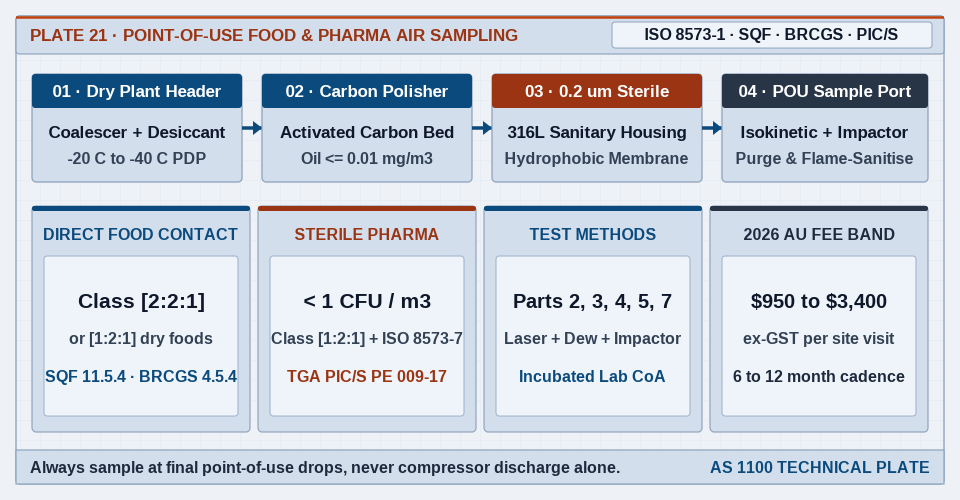
Australian food, beverage, and pharmaceutical plants must validate compressed air at actual point-of-use drops (never compressor discharge alone), pairing ISO 8573-1:2010 [2:2:1] or [1:2:1] purity with ISO 8573-7 viable microbial sampling (<1 CFU/m3) and 0.2 micron sterile filtration.
Passing an Australian SQF, BRCGS, FSANZ, or TGA PIC/S audit requires documented proof that compressed air touching product, primary packaging, or sterile surfaces cannot introduce oil, water, rust, or viable microorganisms.
Buying an oil-free compressor or fitting coalescing filters in the plant room does not satisfy audit evidence on its own. Certification bodies verify analytical results drawn directly from critical point-of-use drops under live production conditions.
1. Australian Audit Matrix: FSANZ, SQF Ed 9, BRCGS Issue 9 & TGA PIC/S
In Australia, FSANZ Food Standards Code Standard 3.2.2 sets the statutory baseline that food-contact gases must not contaminate food. Commercial supermarket and export certification schemes translate that duty into explicit ISO 8573-1:2010 and microbiological test clauses.
For pharmaceutical and sterile therapeutic manufacturing, the Therapeutic Goods Administration enforces PIC/S Guide to GMP PE 009-17 (including revised Annex 1 Clause 6.19), requiring user-defined chemical, particulate, and microbiological qualification at the point of use.
| Application Duty | Governing Clause | Target Class [P:W:O] |
Point-of-Use Polish & Micro |
|---|---|---|---|
| Direct Food & Beverage Contact (sparging, agitation, slicing, pouch blow-open) | FSANZ 3.2.2; SQF Ed 9 Cl 11.5.4; BRCGS Iss 9 Cl 4.5.4 | [2:2:1] or [1:2:1] (-40 °C PDP) |
0.2 µm sterile filter + < 1 CFU/m3 (ISO 8573-7) |
| Hygroscopic Dry Powders (infant formula, flour, sugar conveying) | SQF Ed 9 Cl 11.5.4; HACCP CCP | [1:1:1] (-70 °C PDP) |
Desiccant drying + 0.2 µm sterile membrane + ISO 8573-7 |
| Indirect Contact / Clean Packaging Area (carton erectors, labellers) | SQF Ed 9; BRCGS Iss 9 risk assessment | [2:4:2] (+3 °C PDP) |
0.01 µm coalescing + local exhaust routing away from open product |
| TGA Sterile / Aseptic Pharma Contact (vial purge, lyophiliser, Grade A/B) | TGA PIC/S PE 009-17 Annex 1 Cl 6.19 | [1:2:1] + Grade A/B particle parity |
Integrity-tested 0.2 µm hydrophobic sterile filter + < 1 CFU/m3 |
Use our free ISO 8573-1 Air Purity Specifier to build a line-by-line filtration train before locking in your annual sampling schedule.
2. Point-of-Use Sampling Methods (ISO 8573-2, -3, -4, -5 & -7)
ISO 8573-1:2010 defines purity class limits, while Parts 2 through 9 prescribe the physical sampling protocols. Testing only with cheap colourimetric detector tubes misses sub-micron particles, organic solvent vapours, and viable bacteria.
- Solid Particles (ISO 8573-4:2019): High-pressure laser optical particle counter connected via an isokinetic pressure-diffuser probe measuring
0.1to5.0 µmchannels. - Pressure Dew Point (ISO 8573-3): Calibrated chilled-mirror or polymeric capacitive hygrometer bled to thermal equilibrium at line pressure (verify condensation risk in our Pressure Dew Point Calculator).
- Total Oil Aerosol & Vapour (ISO 8573-2 & ISO 8573-5:2025): Coalescing membrane capture for liquid/aerosol oil combined with charcoal sorbent tubes and thermal-desorption GC-MS for hydrocarbon vapour down to
≤ 0.01 mg/m3(Class 1). - Viable Microorganisms (ISO 8573-7): Sanitised slit-to-agar or sieve impaction sampler drawing a metered compressed air volume onto Tryptic Soy Agar (bacteria) and Sabouraud Dextrose Agar (yeast and mould) plates for NATA laboratory incubation.
3. 2026 Australian Food & Pharma Air Testing Cost Breakdown
Australian testing fees depend on metro versus regional travel, the number of critical drops sampled, and whether hydrocarbon vapour tubes and agar plates require express courier turnaround to a NATA laboratory.
| Testing Component | Analytical Method | 2026 Indicative Fee (ex-GST) | Typical Turnaround |
|---|---|---|---|
| Site Mobilisation & Calibration Setup (metro capital cities) | Sanitised 316L manifold, purge & zero-check | $350 to $650 per visit |
Same-day on site |
| Physical & Chemical Suite per Drop (Particles, PDP & Total Oil) | ISO 8573-3, -4:2019, -2 & -5:2025 | $220 to $420 per outlet |
3 to 7 business days |
| Viable Microbial Impaction per Drop (Bacteria, Yeast & Mould) | ISO 8573-7 impaction + NATA plate incubation + field blank | $180 to $340 per outlet |
5 to 10 business days |
| Typical 4-Drop Food / Beverage Audit Package (1 header + 3 contact drops) | Full ISO 8573-1 class certificate + NATA microbial report | $1,650 to $2,950 total |
7 to 10 business days |
| TGA Pharma Sterile Suite + 0.2 µm Filter Integrity | Full ISO 8573 + bubble-point / diffusive-flow + GMP QA pack | $2,400 to $4,800+ total |
10 to 14 business days |
Note that occupational breathing-air hoods on washdown or spray crews follow a separate statutory standard (AS/NZS 1715:2009 CO/CO2 testing); see our Breathing Air Quality Testing Australia guide.
4. Audit Cadence, Sterile 0.2 Micron Filters & Re-Test Triggers
Under SQF Edition 9 and BRCGS Issue 9, direct food-contact compressed air is tested at least annually, though high-care dairy, infant formula, craft canning, and pharmaceutical plants standardise on 6-monthly verification to catch seasonal summer dewpoint drift.
Point-of-use 0.2 µm hydrophobic PTFE sterile cartridges cannot survive liquid water carryover. Always protect them upstream with a functioning dryer, a 0.01 µm coalescing stage, and an activated-carbon tower, and replace sterile elements every 6 to 12 months or per sterilisation-cycle caps.
Schedule an immediate out-of-cycle re-test after any dryer breakdown, compressor oil-separator failure, ring-main modification, or elevated environmental swab count. For broader plant design rules, compare FSANZ Food Compressed Air and TGA Pharmaceutical Compressed Air.
5. Request a 1-to-1 Food, Beverage or Pharma Air Testing Quote
Need independent ISO 8573-1 and ISO 8573-7 point-of-use testing ahead of an SQF, BRCGS, Coles/Woolworths, or TGA audit? Submit your site location and number of drops below for a 1-to-1 specialist introduction.
Matched 1-to-1 with one vetted independent Australian specialist (choose direct introduction or Ask-First permission check below; how we are paid).
6. Frequently asked questions
Does an oil-free Class 0 compressor remove the need for point-of-use ISO 8573-1 testing?
No. Compressor-room Class 0 certification only measures compressor discharge under test-cell conditions. Ambient hydrocarbons, legacy pipework residue, moisture, and viable microbes in distribution headers still require point-of-use verification under SQF Edition 9 Clause 11.5.4, BRCGS Issue 9 Clause 4.5.4, and PIC/S PE 009-17 Annex 1.
How many compressed air drops should a food or pharmaceutical plant test?
Most GFSI and TGA auditors expect at least one compressor-room baseline after main drying and filtration plus representative worst-case point-of-use drops on every direct product-contact or sterile packaging line, typically 3 to 8 outlets per facility.
How much does ISO 8573-1 and microbial compressed air testing cost in Australia?
A standard 2026 Australian site visit covering technician mobilisation, laser particle counting, chilled-mirror dewpoint, oil aerosol/vapour sampling, and ISO 8573-7 agar incubation across 3 to 5 drops typically costs $1,450 to $3,400 ex-GST. To request a scoped quote, use the form above.
Is NATA accreditation mandatory for SQF, BRCGS, or TGA compressed air testing?
GFSI and TGA auditors require calibrated instrumentation traceable to national standards, documented ISO 8573 test methods, and NATA-accredited microbiological plate incubation where viable CFU/m3 limits apply. Verify your auditor scope before booking a generic workshop air check.