
On this page (7 sections)
- 1.How Much Condensate Does an Australian Compressor Produce?
- 2.Condensate Drain Types: Zero-Loss vs Timed Solenoid at $0.27/kWh
- 3.Oil-Water Separators & The Synthetic Lubricant Emulsion Trap
- 4.Australian Water Authority Trade-Waste Rules by State
- 5.Monthly Verification & Maintenance Routine
- 6.Request 1-to-1 Condensate Separator & Zero-Loss Drain Quote
- 7.Frequently asked questions
Never discharge untreated compressed air condensate to stormwater. Even a small oil-injected rotary screw compressor generates hundreds to thousands of litres of oil-contaminated water each year from aftercoolers, wet air receivers, coalescing filters, and refrigerated dryers.
In Australia, untreated condensate violates state EPA environmental protection laws and local water authority trade-waste rules. You must route condensate through a properly sized oil-water separator (or licensed liquid-waste collection) and confirm treated effluent meets your water utility's oil-and-grease limit before discharging to sewer / trade waste.
1. How Much Condensate Does an Australian Compressor Produce?
Warm, humid Australian coastal air holds significant moisture. In Brisbane, Sydney, Darwin, or summer Melbourne conditions (30 C ambient, 70% relative humidity), a single 37 kW rotary screw compressor running 4,000 hours per year can produce over 40,000 litres of condensate annually.
Typically 95% to 99% of that volume is water, and 1% to 5% is entrained compressor lubricant, rust scale, and airborne dirt. Without effective separation, paying a waste contractor to haul 40,000 L of untreated water off site quickly costs more than installing a compliant on-site oil-water separator.
2. Condensate Drain Types: Zero-Loss vs Timed Solenoid at $0.27/kWh
How you get condensate out of your receivers and filters matters almost as much as how you treat it. Timed solenoid drains blow live compressed air on every cycle, quietly burning electricity at $0.27/kWh:
| Drain Type | Compressed Air Waste | Annual Power Loss (7 bar, 4,000 h) | Trade-Waste & Maintenance Fit |
|---|---|---|---|
| Zero-loss capacitive drain | Virtually 0% (opens only on liquid) | ~$0 / year | Best for receivers, dryers & separators (prevents emulsification) |
| Timed solenoid drain | High (blows air every 5 to 15 mins) | $450 to $1,600+ / drain / yr | High air waste; violently shears oil into hard-to-treat emulsion |
| Mechanical float drain | Low when clean, high if stuck open | Variable (risk of stuck-open leak) | Acceptable on clean point-of-use filters; inspect monthly |
| Cracked manual ball valve | Severe continuous orifice leak | $1,500 to $4,000+ / valve / yr | Never acceptable; replace immediately |
Engineering tip: Upgrading 4 timed solenoid drains to zero-loss level-sensing drains typically pays back in under 12 months from electricity savings alone, while making your oil-water separator work far more effectively.
3. Oil-Water Separators & The Synthetic Lubricant Emulsion Trap
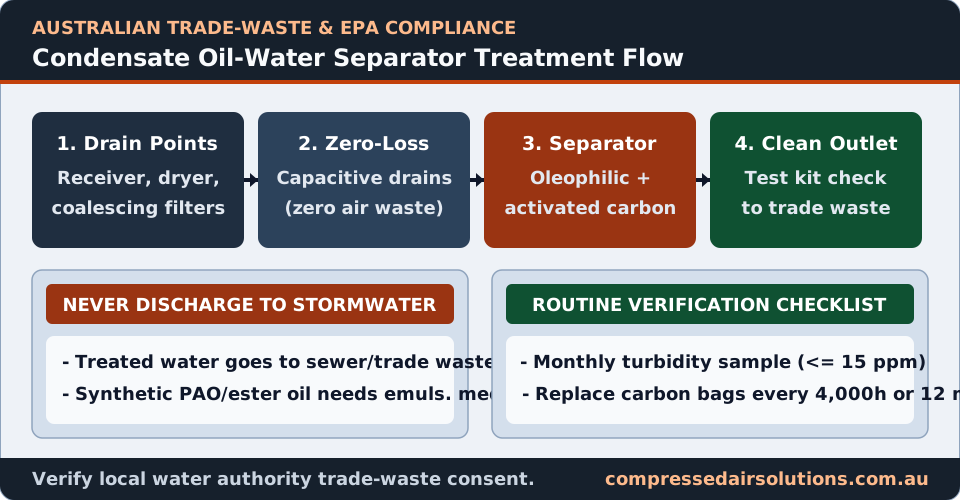
Standard gravity oil-water separators use a depressurisation chamber followed by oleophilic (oil-attracting) media and an activated carbon polishing stage to reduce residual oil below 10 to 20 mg/L (ppm).
Watch out for synthetic lubricants (such as polyglycol, diester, or heavily emulsified PAO oils). High-velocity timed drains and certain synthetic coolants form stable white emulsions that pass straight through basic gravity separators. Always match your separator media (adsorption / organoclay / emulsion-splitting cartridges) to the exact compressor oil on your site's Safety Data Sheet (SDS).
4. Australian Water Authority Trade-Waste Rules by State
Discharge to stormwater is prohibited nationwide. Discharge of treated separator water to sewer is regulated by your local water authority under commercial trade-waste agreements:
- NSW (Sydney Water / Hunter Water): Commercial trade-waste consent required; oil and grease limits strictly enforced; zero stormwater discharge under NSW POEO Act.
- Victoria (Yarra Valley Water / Greater Western Water / South East Water): Trade-waste agreement applies for industrial premises; retain separator servicing records and turbidity checks.
- Queensland (Urban Utilities / Unitywater / regional councils): Trade-waste approval required; high coastal humidity demands larger separator sizing and more frequent carbon media swaps.
- South Australia (SA Water) & Western Australia (Water Corporation WA): Industrial trade-waste permit required; verify hydrocarbon/oil-and-grease thresholds (
typically ≤ 10 to 20 mg/Lfor hydrocarbons depending on catchment) before commissioning.
5. Monthly Verification & Maintenance Routine
An oil-water separator only protects you legally if its media is active. Run this 5-minute monthly checklist:
- Test-bottle turbidity check: Draw a clear sample from the separator outlet port and compare against the manufacturer's reference turbidity card (
10 to 20 ppmthreshold). - Inspect zero-loss drains: Press the manual test button on each receiver, dryer, and filter drain to confirm clean discharge with zero stuck-open hiss.
- Replace media on schedule: Swap oleophilic and activated carbon bags every
4,000running hours or12months (whichever comes first), disposing of spent oil-saturated bags as regulated industrial waste. - Log every check: Keep sample results and media replacement dates in your plant maintenance logbook alongside your air compressor maintenance schedule.
6. Request 1-to-1 Condensate Separator & Zero-Loss Drain Quote
Share your installed compressor kW, lubricant type, and state below for a 1-to-1 introduction to an independent Australian specialist to size zero-loss drains and compliant trade-waste oil-water separation.
Matched 1-to-1 with one vetted independent Australian specialist (choose direct introduction or Ask-First permission check below; how we are paid).
7. Frequently asked questions
Do oil-free air compressors still need condensate management?
Often yes. While an ISO 8573-1 Class 0 oil-free compressor adds no lubricant, it still concentrates airborne hydrocarbons, diesel exhaust, and atmospheric pollutants sucked into the plant intake. Test condensate pH and hydrocarbon levels before assuming it can enter sewer untreated.
How much does an industrial oil-water separator cost in Australia?
For a typical 15 kW to 75 kW Australian workshop or factory, a properly sized oleophilic + activated carbon oil-water separator costs roughly $800 to $3,500 AUD supplied, plus annual replacement media kits ($250 to $900/yr). That is a fraction of licensed liquid-waste pump-out fees.
Can I pipe multiple compressors into one central oil-water separator?
Yes, provided the separator is sized for the combined maximum FAD (derated for high summer humidity and synthetic oil type) and each drain feeds into a properly vented manifold header so back-pressure cannot stall lower-pressure filter drains.