
On this page (6 sections)
- 1.2026 Australian Ultrasonic Leak Survey & ISO 11011 Audit Fee Bands (ex-GST)
- 2.40 kHz Acoustic Imaging Cameras vs Handheld Probes: What to Demand
- 3.$0.30/kWh Leak Repair Payback Maths & Excess Pressure Savings
- 4.NSW ESS & Victorian VEU Rebate Eligibility (ISO 11011 Baseline M&V)
- 5.Request My Introduction for an Ultrasonic Leak Survey or ISO 11011 Audit
- 6.Frequently asked questions
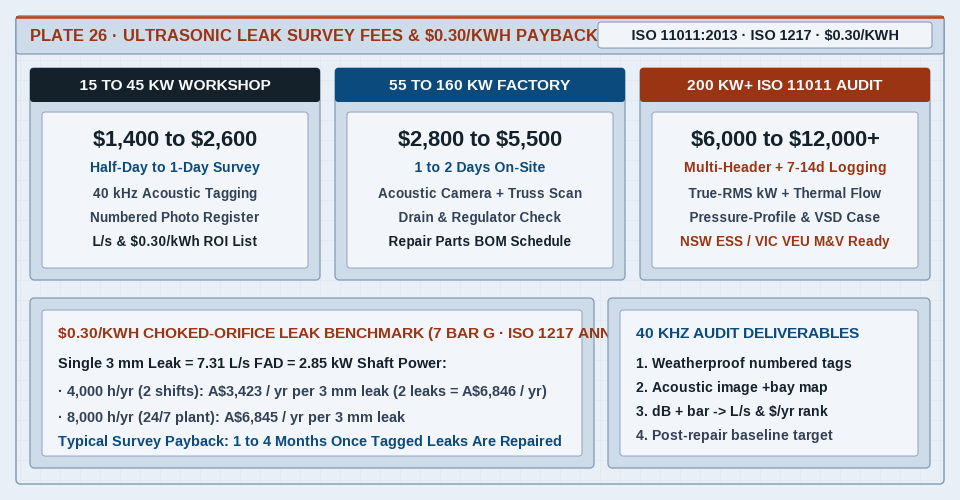
Direct Answer: In Australia in 2026, a commercial 40 kHz ultrasonic compressed-air leak survey typically costs A$1,400 to A$2,600 ex-GST for a 15 to 45 kW workshop, A$2,800 to A$5,500 for a 55 to 160 kW manufacturing site, and A$6,000 to A$12,000+ for 200 kW+ multi-header plants including ISO 11011:2013 logging.
At the $0.30/kWh Australian benchmark (ISO 1217:2009 Annex C, 100 kPa, 6.50 kW/m3/min), one 3 mm leak at 7 bar(g) wastes 7.31 L/s (2.85 kW) = A$3,423/yr at 4,000 h, so repairing just two 3 mm leaks recovers A$6,846/yr.
1. 2026 Australian Ultrasonic Leak Survey & ISO 11011 Audit Fee Bands (ex-GST)
Survey pricing scales with floor area, overhead ring-main height, drop count, and whether you need a half-day ultrasonic tag-and-quantify walk-through or a full 7 to 14 day instrumented ISO 11011:2013 supply-and-demand assessment.
| Plant Scale | Typical Survey Scope | On-Site Time | 2026 Indicative Fee (ex-GST) |
|---|---|---|---|
| Single Workshop (15 to 45 kW) | 40 kHz ultrasonic scan, numbered physical tags & $/yr ROI list (up to 40 drops) | Half-day to 1 day | $1,400 to $2,600 |
| Medium Factory (55 to 160 kW) | Acoustic imaging camera scan across overhead headers, FRLs, drains & machines + BOM | 1 to 2 days | $2,800 to $5,500 |
| Large / Multi-Header (200 kW+) | Multi-building ultrasonic survey + 7 to 14 day True-RMS kW, pressure & flow logging | 3 to 5 days + logging | $6,000 to $12,000+ |
| Add-On: 7-14 Day ISO 11011 Logging | Clamp-on True-RMS kW meters + insertion thermal mass flow & dewpoint loggers | 7 to 14 days | +$1,500 to $3,800 |
| Optional Turnkey Repair Crew | Replacement quick-couplings, push-in fittings, FRL bowls & zero-loss drain swaps | Per technician day | $1,100 to $1,650 / day + parts |
Estimate your own site's current orifice waste before booking an auditor in our free Compressed Air Leak Cost Calculator.
2. 40 kHz Acoustic Imaging Cameras vs Handheld Probes: What to Demand
Unchecked Australian factories commonly lose 20% to 35% of generated FAD through worn brass quick-connects, cracked polyurethane push-in tubing, stuck float drains, and weeping pneumatic cylinders.
Modern multi-microphone 40 kHz acoustic imaging cameras overlay a real-time sound-intensity heatmap onto a visual photograph, spotting overhead 8 m ring-main flange leaks from the floor without hiring a scissor lift just to locate them.
- Weatherproof numbered physical tags: Every leak must be cable-tied at the exact component so maintenance fitters do not waste hours re-hunting leaks weeks later.
- Quantified L/s & $0.30/kWh priority table: Insist on per-tag photos, bay location, decibel-to-
L/sflow estimate at line pressure, required spare part, and annualAUDloss sorted largest-first. - Condensate drain & blow-gun check: Ensure the auditor inspects timed solenoid drains and bypassed manual drain valves (see Condensate Management Guide).
3. $0.30/kWh Leak Repair Payback Maths & Excess Pressure Savings
Under choked-orifice flow physics calibrated to ISO 1217:2009 Annex C (100 kPa, 20 °C, discharge coefficient 0.65, specific power 6.50 kW per m3/min at 7 bar(g)), leak cost scales with the square of hole diameter:
- 1.5 mm leak (weeping push-in fitting): Loses
1.83 L/s(0.71 kW) =A$856/yrat4,000 horA$1,711/yrat8,000 h($0.30/kWh). - 3.0 mm leak (worn quick-connect coupling): Loses
7.31 L/s(2.85 kW) =A$3,423/yrat4,000 horA$6,845/yrat8,000 h. Repairing just two3 mmcouplings savesA$6,846/yron two-shift operation. - Discharge pressure bonus (6% to 7% per bar): Once leaks are sealed and header velocity drops, plants can frequently lower compressor cut-out pressure by
0.8to1.0 bar, trimming total compressor kW by a further5%to7%.
4. NSW ESS & Victorian VEU Rebate Eligibility (ISO 11011 Baseline M&V)
Under the NSW Energy Savings Scheme (ESS) (IHEAB / PIAM&V methods) and Victorian Energy Upgrades (VEU), routine maintenance such as fixing air leaks rarely generates tradeable energy certificates on its own.
However, if your survey reveals an oversized fixed-speed compressor running unloaded, commissioning an Accredited Certificate Provider (ACP / AP) to log 7 to 14 days of pre-upgrade kW and flow under ISO 11011:2013 BEFORE purchasing a VSD trim machine preserves certificate eligibility (see Australian Compressed Air Grants & Incentives).
5. Request My Introduction for an Ultrasonic Leak Survey or ISO 11011 Audit
Want a fixed-fee quote for an independent 40 kHz acoustic-camera leak survey or 7-day ISO 11011 baseline audit in your state? Share your total compressor kW, shift hours, and postcode below to request a 1-to-1 specialist introduction.
6. Frequently asked questions
How much does an ultrasonic compressed air leak survey cost in Australia in 2026?
In 2026, a commercial 40 kHz ultrasonic leak survey with numbered physical tags and a quantified repair register typically costs A$1,400 to A$2,600 ex-GST for a 15 to 45 kW workshop, A$2,800 to A$5,500 for a 55 to 160 kW factory, and A$6,000 to A$12,000+ for multi-header plants.
Can an ultrasonic leak survey be completed while production machines are running?
Yes. Directional 40 kHz ultrasonic probes and multi-microphone acoustic imaging cameras isolate high-frequency turbulent orifice hiss well above audible factory noise, and in fact require lines to remain at normal working pressure so coupling, regulator, and cylinder-seal leaks are active.
How fast does a compressed air leak survey pay back at $0.30/kWh?
At $0.30/kWh and 7 bar(g), a single 3 mm equivalent leak wastes 7.31 L/s (2.85 kW), costing A$3,423/yr across 4,000 h or A$6,845/yr across 8,000 h. Fixing two 3 mm leaks saves A$6,846/yr and pays back a standard survey inside 2 to 5 months.
Does a standalone leak survey qualify for NSW ESS or Victorian VEU energy certificates?
Routine leak repair is classified as maintenance and generally does not generate ESCs or VEECs on its own. However, adding 7 to 14 days of ISO 11011:2013 kW and flow baseline logging creates the accredited M&V baseline needed before a VSD compressor upgrade. Use the form above to request an introduction.