
On this page (6 sections)
- 1.2026 Australian Compressed Air Dryer Price Bands (20 to 500 L/s, ex-GST)
- 2.ISO 7183:2007 Option A1 vs Australian 45 °C Summer Derating (Option A2)
- 3.10-Year Purge-Air Electricity TCO at $0.30/kWh (Why Cheap Heatless Dryers Cost 6x)
- 4.Pre/After-Filtration, Zero-Loss Drains & AS 4343 Tower Registration
- 5.Request My Introduction for 45 °C Summer-Rated Dryer Quotes
- 6.Frequently asked questions
Direct Answer: In Australia in 2026, stand-alone refrigerated compressed air dryers (+3 °C PDP, ISO 8573-1 Class 4) typically cost A$1,850 to A$19,500 ex-GST from 20 to 500 L/s, while twin-tower desiccant dryers (-40 °C Class 2 to -70 °C Class 1) range from A$5,800 to A$68,000+ (equipment only).
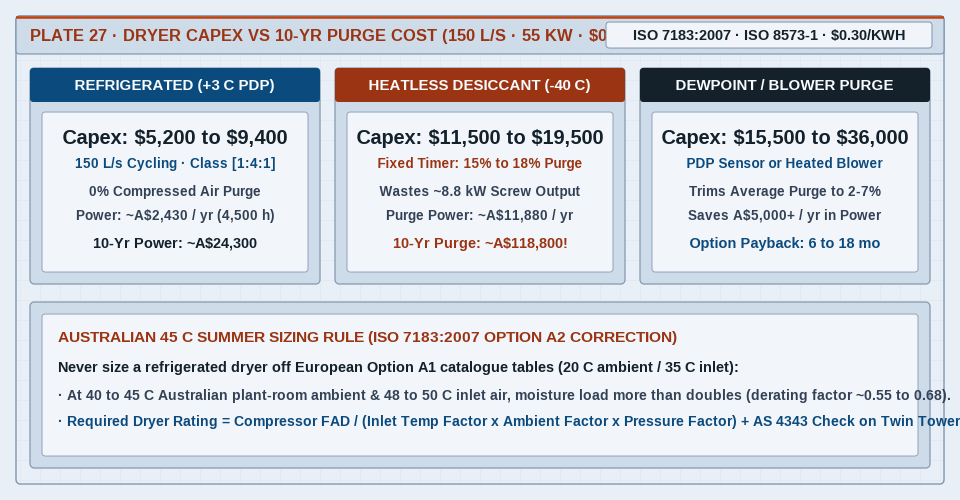
Before comparing purchase prices, check 10-year electricity at $0.30/kWh: a cheap fixed-timer heatless desiccant dryer consuming 15% to 18% purge air on a 55 kW screw compressor burns A$10,500 to A$12,500/yr in wasted compressed air.
1. 2026 Australian Compressed Air Dryer Price Bands (20 to 500 L/s, ex-GST)
Supply-only equipment price bands below reflect dryers sized for 7 to 10 bar(g) industrial service. Allow an additional A$900 to A$3,800 ex-GST for pre/after coalescing filter housings, bypass manifold valves, electrical hook-up, and condensate drain piping.
Flow Band (FAD) |
Refrigerated (+3 °C) |
Heatless Desiccant (-40 °C) |
Heated / Blower Purge | HOC Desiccant (Oil-Free) |
|---|---|---|---|---|
20 to 45 L/s (7.5-15 kW) |
$1,850 to $3,900 |
$5,800 to $10,500 |
N/A (use PDP sensor on heatless) | N/A |
60 to 120 L/s (22-45 kW) |
$3,800 to $6,900 |
$9,500 to $16,500 |
$19,000 to $31,000 |
N/A |
150 to 280 L/s (55-90 kW) |
$5,800 to $11,800 |
$14,500 to $26,500 |
$28,000 to $48,000 |
$42,000 to $68,000 |
320 to 500 L/s (110-160 kW) |
$10,500 to $19,500 |
$24,000 to $42,000 |
$44,000 to $72,000+ |
$62,000 to $98,000+ |
Confirm whether your application truly requires -40 °C desiccant drying or whether +3 °C refrigerated Class 4 air is sufficient using our ISO 8573-1 Air Purity Specifier and Pressure Dew Point Calculator.
2. ISO 7183:2007 Option A1 vs Australian 45 °C Summer Derating (Option A2)
Most imported dryer brochures headline flow capacity under ISO 7183:2007 Option A1 temperate reference conditions (20 °C ambient, 35 °C inlet compressed air, 7 bar(g)). Australian plant rooms routinely hit 38 to 45 °C in January and February, pushing compressor aftercooler discharge to 48 to 52 °C.
Because saturated air at 50 °C carries more than double the water vapour mass of air at 35 °C, an Option A1 dryer loses 32% to 45% of its rated capacity under ISO 7183 Option A2 tropical/Australian conditions:
- Corrected sizing formula: Required Catalogue Flow = Compressor FAD divided by (
C_inlet×C_ambient×C_pressure). - Worked 150 L/s example: At
42 °Cambient (C_amb = 0.82),48 °Cinlet (C_in = 0.72), and7 bar(g)(C_p = 1.00), combined factor =0.59, requiring a255 L/snominal dryer so liquid condensate never breaks through into factory tools.
3. 10-Year Purge-Air Electricity TCO at $0.30/kWh (Why Cheap Heatless Dryers Cost 6x)
Compare 10-year operating energy across a 150 L/s (55 kW) factory running 4,500 h/yr at the $0.30/kWh Australian electricity benchmark:
- Cycling refrigerated dryer (+3 °C): Draws
~1.8 kWaverage electrical power with0%air loss =8,100 kWh/yr=A$2,430/yr(A$27,000over 10 years). - Fixed-timer heatless desiccant (-40 °C, 16% purge): Vents
24 L/sof dry compressed air continuously to atmosphere, consuming~8.8 kWof compressor shaft power =39,600 kWh/yr=A$11,880/yr(A$118,800over 10 years). - Dewpoint-demand or blower-purge desiccant (2% to 7% average purge): Adding a capacitive dewpoint transmitter (
A$2,200toA$3,800upgrade) freezes tower switching during part-load shifts, savingA$5,000toA$7,500/yrat$0.30/kWh(compare Refrigerated vs Desiccant Dryers).
4. Pre/After-Filtration, Zero-Loss Drains & AS 4343 Tower Registration
Every desiccant dryer requires a staged 1.0 micron bulk + 0.01 micron high-efficiency coalescing pre-filter pair (to stop compressor oil coating activated alumina/molecular sieve) plus a 1.0 micron high-temperature particulate after-filter to catch desiccant dust.
On larger twin-tower skids (typically ≥ 150 to 250 L/s depending on tower volume), check each desiccant chamber's individual P × V product in our AS 4343 Hazard Level Calculator.
Towers exceeding 31.6 MPa.L require design registration, above 100 MPa.L require state item registration (such as Work Health and Safety Regulation 2025 (NSW) section 246; exempt in Victoria), and above 150 MPa.L require AS/NZS 3788:2024 inspections plus AS 1271 relief valve checks.
5. Request My Introduction for 45 °C Summer-Rated Dryer Quotes
Replacing a water-logged refrigerated dryer or sizing a low-purge -40 °C desiccant train? Share your compressor kW, flow rate, target dew point, and state below to request a 1-to-1 introduction to an independent Australian compressed air treatment specialist.
6. Frequently asked questions
How much does a refrigerated compressed air dryer cost in Australia in 2026?
In 2026, industrial stand-alone refrigerated dryers (+3 °C pressure dew point, ISO 8573-1 Class 4) typically cost A$1,850 to A$3,900 ex-GST for 20 to 45 L/s workshops, A$4,200 to A$9,400 for 60 to 280 L/s factories, and A$10,500 to A$19,500 for 320 to 500 L/s plants.
Why do European-rated refrigerated dryers pass liquid water in Australian summers?
Catalogue flow ratings published to ISO 7183:2007 Option A1 assume 20 °C room ambient and 35 °C inlet air. In a 40 to 45 °C Australian plant room with 48 °C inlet air (Option A2), water vapour load more than doubles, requiring a 1.4x to 1.8x oversized dryer plus clean aftercooling.
When is a desiccant air dryer worth the extra capital and $0.30/kWh purge cost?
Specify a -40 °C (Class 2) or -70 °C (Class 1) desiccant dryer only when lines run outdoors below freezing or when direct food, pharmaceutical, powder-conveying, spray-booth, or laser/N2 processes mandate sub-zero dew points. Always add dewpoint-demand purge switching to cut $0.30/kWh purge waste.
Do twin-tower desiccant air dryers require WHS pressure vessel registration?
Often yes on larger skids. Each desiccant chamber is assessed individually under AS 4343:2014 (P × V). Towers exceeding 31.6 MPa.L require design registration, above 100 MPa.L require item registration (outside Victoria), and above 150 MPa.L require AS/NZS 3788:2024 inspections. Use the form above for quotes.