
On this page (6 sections)
- 1.2026 Australian Air Compressor Hire Rate Bands (Weekly & Monthly, ex-GST)
- 2.415V Electric vs Diesel Hire: 4-Week Fuel & Carbon Maths ($0.30/kWh vs Diesel)
- 3.Hire vs Purchase Crossover: Shutdowns, Winery Vintage & Lead-Time Bridging
- 4.Statutory WHS Checks on Hired Air Receivers, Hose Whip & Breathing Air
- 5.Request My Introduction for Industrial Air Compressor Hire or Bridge Supply
- 6.Frequently asked questions
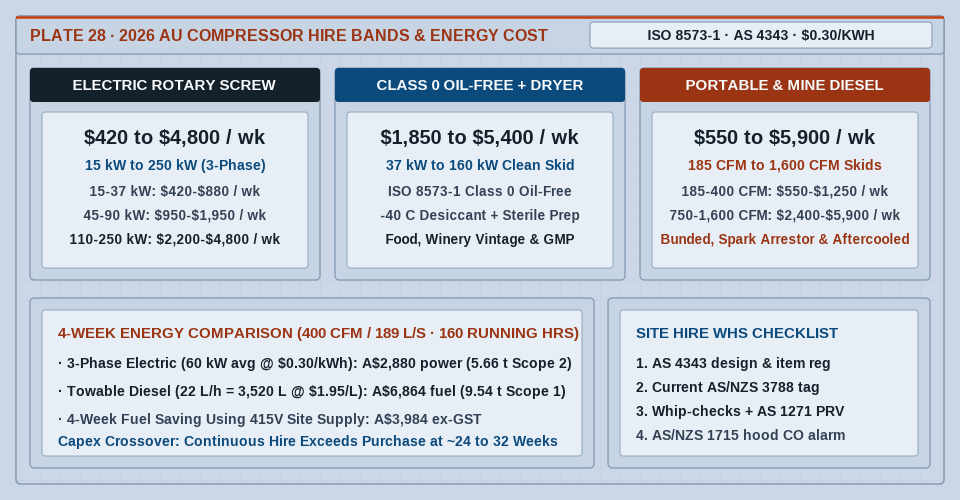
Direct Answer: In Australia in 2026, dry-hire weekly rates (ex-GST) typically range from A$420 to A$880/wk for a 15 to 37 kW electric rotary screw, A$950 to A$1,950/wk for 45 to 90 kW, A$1,850 to A$5,400/wk for an ISO 8573-1:2010 Class 0 oil-free + desiccant dryer skid, and A$550 to A$5,900/wk for 185 to 1,600 CFM towable or mine-spec diesel compressors.
Where 415 V three-phase site power is available, hiring an electric rotary screw rather than a diesel portable typically cuts energy spend by more than half: across a 4-week (160 h) single-shift shutdown at ~400 CFM (189 L/s), 60 kW average electric draw at $0.30/kWh costs A$2,880 versus A$6,864 in diesel at 22 L/h and A$1.95/L ex-GST (saving A$3,984 in 4 weeks).
1. 2026 Australian Air Compressor Hire Rate Bands (Weekly & Monthly, ex-GST)
Indicative 2026 commercial dry-hire equipment rates below reflect multi-week industrial bookings across Sydney, Melbourne, Brisbane, Perth, Adelaide, and regional hubs. Mobilisation/demobilisation (tilt-tray or HIAB crane), 6 to 20 m flexible bull-hose sets, distribution manifolds, and fuel are billed separately.
| Hire Equipment Category | Typical Flow & Pressure | Indicative Weekly Hire (ex-GST) | Indicative 4-Week / Monthly (ex-GST) |
|---|---|---|---|
| 15 to 37 kW Electric Screw | 31 to 104 L/s (65 to 220 CFM) @ 7 to 10 bar(g) |
A$420 to A$880 / wk |
A$1,350 to A$2,850 / mo |
| 45 to 90 kW Electric Screw (Fixed / VSD) | 123 to 260 L/s (260 to 550 CFM) @ 7 to 10 bar(g) |
A$950 to A$1,950 / wk |
A$3,100 to A$6,200 / mo |
| 110 to 250 kW Containerised Electric | 307 to 708 L/s (650 to 1,500 CFM) @ 7 to 10 bar(g) |
A$2,200 to A$4,800 / wk |
A$7,000 to A$15,500 / mo |
| 37 to 160 kW Class 0 Oil-Free + Dryer Skid | 95 to 450 L/s @ -40 °C PDP + coalescing/sterile prep |
A$1,850 to A$5,400 / wk |
A$5,900 to A$17,500 / mo |
| 185 to 400 CFM Towable Diesel Portable | 87 to 189 L/s @ 7 to 12 bar(g) (civil / blasting) |
A$550 to A$1,250 / wk |
A$1,750 to A$3,950 / mo |
| 750 to 1,600 CFM Mine-Spec Diesel Skid | 354 to 755 L/s @ 10 to 24 bar(g) (bunded, aftercooled) |
A$2,400 to A$5,900 / wk |
A$7,800 to A$18,800 / mo |
| Stand-Alone Dryer / AS 1210 Receiver Add-On | Refrigerated/desiccant dryer or 500 to 2,000 L wet/dry buffer |
A$180 to A$950 / wk |
A$580 to A$2,900 / mo |
Confirm the required Free Air Delivery (FAD) under ISO 1217:2009 Annex F reference conditions before booking a hire skid using our free Compressor Sizing Calculator.
2. 415V Electric vs Diesel Hire: 4-Week Fuel & Carbon Maths ($0.30/kWh vs Diesel)
Plant managers frequently default to hiring a towable diesel compressor during a breakdown or shutdown because it avoids an electrician hook-up, overlooking how quickly diesel burn dwarfs the hire invoice itself.
- 3-Phase 415 V Electric Screw (75 kW nominal, 60 kW average input over 160 h / 4 weeks): Consumes
9,600 kWh. At the$0.30/kWhAustralian industrial benchmark, electricity costsA$2,880and emits5.66 tonnesof Scope 2 CO2-e (plus0.96 tonnesof Scope 3 CO2-e at the DCCEEW National Greenhouse Accounts Factors 2026 Table 1 national average of0.59 / 0.10 kg CO2-e/kWh). - Towable 400 CFM Diesel Compressor (22 L/h average burn = 3,520 L over 160 h): At an indicative net industrial diesel cost of
A$1.95/Lex-GST, fuel costsA$6,864(an extraA$3,984in 4 weeks, orA$9,960more on a two-shift400 hmonth). Under DCCEEW NGA Factors 2026 Table 8 (diesel oil energy content38.6 GJ/kL, Scope 1 combined factor70.20 kg CO2-e/GJ), burning3.520 kL(135.87 GJ) releases9.54 tonnesof direct Scope 1 CO2-e on site. - Licensed electrical tie-in payback: Even allowing
A$900toA$1,800for a licensed electrician to connect temporary cables to a spare415 Vcircuit breaker under AS/NZS 3000:2018 (incorporating Amendment 3:2023), electric hire typically pays back its hook-up inside 5 to 9 single-shift running days (at ~A$199 per 8-hour day saved) while eliminating diesel exhaust fumes near building intakes.
3. Hire vs Purchase Crossover: Shutdowns, Winery Vintage & Lead-Time Bridging
Comparing weekly dry-hire invoices against 2026 Australian Industrial Air Compressor Prices shows a consistent capital crossover window (see also our Rent vs Buy Compressor Guide):
- Short-term breakdown, turnaround, or seasonal peak (≤ 12 weeks/yr): Hiring wins decisively. An 8-week winery vintage crush or food-plant seasonal peak hiring a
75 kWpackage forA$9,500toA$13,500/yr(including transport) avoids tying upA$34,000toA$46,000+in capital that would otherwise sit idle or cycle unloaded for 44 weeks of the year. - Continuous base-load operation (≥ 24 to 32 weeks): Cumulative dry-hire charges on a
45to90 kWscrew cross the outright purchase price of a new machine after roughly 6 to 8 months. If a new VSD or oil-free compressor has a 12 to 16 week factory lead time, negotiate a hire-rebate or bridge-hire rate up front rather than rolling month-to-month.
4. Statutory WHS Checks on Hired Air Receivers, Hose Whip & Breathing Air
Under Australian State and Territory WHS Regulations (including Model WHS Regulations r. 224, r. 237, and r. 246, New South Wales Work Health and Safety Regulation 2025, and Victoria's OHS Regulations 2017), the workplace PCBU or employer controlling the site shares statutory duties for hired pressure plant brought onto the premises:
- Hired receiver registration & inspection papers: Any hired vertical air receiver or twin-tower desiccant dryer exceeding AS 4343:2014 Hazard Level D/C thresholds must arrive with its plant design registration number, current plant item registration certificate where required by the applicable jurisdiction (generally Hazard Levels A to C outside Victoria, subject to statutory Schedule 5 exemptions such as qualifying serially produced vessels), calibrated AS 1271 safety valve tag, and current AS/NZS 3788:2024 inspection report.
- Aftercoolers, water separators & whip restraints: Standard civil diesel compressors without an integral aftercooler discharge hot wet air that destroys desiccant beds and pneumatic tools; specify an aftercooled + water-separated skid, fit whip-check restraints across every claw/camlock hose coupling, and bund oil/condensate drips away from stormwater drains.
- Abrasive blasting & spray-booth breathing air: Never connect a supplied-air respirator hood directly to an oil-lubricated hire compressor without a dedicated AS/NZS 1715:2009 Appendix A breathing-air filtration panel, carbon monoxide monitor/alarm (
CO ≤ 10 ppm,CO2 ≤ 800 ppm, oil≤ 1 mg/m³), and positioning the compressor air intake upwind of, and well separated from, diesel engine exhaust and other contamination sources (see Breathing Air Quality Testing Guide).
5. Request My Introduction for Industrial Air Compressor Hire or Bridge Supply
Want a fixed-fee quote for an independent 40 kHz acoustic-camera leak survey or 7-day ISO 11011 baseline audit in your state? Share your total compressor kW, shift hours, and postcode below to request a 1-to-1 specialist introduction.
6. Frequently asked questions
How much does it cost to hire an industrial air compressor in Australia in 2026?
In 2026, Australian commercial dry-hire rates typically run A$420 to A$880/wk ex-GST for 15 to 37 kW electric rotary screws, A$950 to A$1,950/wk for 45 to 90 kW, A$1,850 to A$5,400/wk for ISO 8573-1 Class 0 oil-free + desiccant dryer skids, and A$550 to A$5,900/wk for 185 to 1,600 CFM portable or mine-spec diesel packages (excluding transport and fuel).
Is it cheaper to hire a 3-phase electric or diesel portable compressor?
Whenever spare 415 V capacity exists, electric hire is substantially cheaper to run. Over 160 running hours (4 single-shift weeks) at ~400 CFM, 60 kW electric draw at $0.30/kWh costs A$2,880 versus A$6,864 in diesel at 22 L/h and A$1.95/L ex-GST, saving nearly A$4,000 in energy per month.
When do food, winery, or pharmaceutical sites need Class 0 oil-free hire packages?
FSANZ Standard 3.2.2, SQF, BRCGS, and TGA PIC/S PE 009-17 require compressed air contacting product or primary packaging to be safe and free from contamination under your site's documented HACCP or Contamination Control Strategy rather than prescribing one universal ISO class.
Where temporary air feeds hygienic or product-contact lines, we strongly recommend specifying a dedicated ISO 8573-1:2010 Class 0 oil-free hire compressor, clean stainless/PTFE transfer hoses, and a desiccant dryer (typically -40 °C PDP where sub-freezing or microbial control applies) matched to your risk assessment to avoid lubricant carryover into clean ring mains.
Who is responsible for WHS plant registration on a hired air receiver?
Both the hire supplier and the host workplace PCBU/employer hold concurrent duties under State WHS Regulations (and Victoria's OHS Regulations 2017). Before pressurising any hired receiver on site, sight its current plant item registration certificate (where applicable), AS/NZS 3788:2024 inspection tag, and calibrated AS 1271 relief valve tag.